


Choosing the right countertop is one of the most important decisions when remodeling your kitchen. Your countertops influence the overall appearance of the space, affect everyday cooking and cleaning, and contribute to the long-term value of your home.
Two popular options for modern kitchens are quartz and porcelain countertops. Both offer attractive designs, excellent stain resistance, and relatively low maintenance. However, they differ in heat resistance, edge durability, installation requirements, and design possibilities.
For homeowners planning a kitchen renovation in Los Angeles, understanding these differences can help you make a confident decision that fits your lifestyle and budget.
In this guide, we’ll compare quartz vs. porcelain countertops and explain which material may be the better choice for your kitchen.

What Are Quartz Countertops?
Quartz countertops are engineered surfaces made primarily from natural quartz particles combined with resins, pigments, and other ingredients. This manufacturing process creates a consistent surface available in a wide variety of colors, patterns, and finishes.
Quartz is especially popular in contemporary kitchens because it can replicate the appearance of natural stone while offering predictable patterns and straightforward everyday care.
Benefits of Quartz Countertops
1. Excellent stain resistance
Quartz surfaces are generally nonporous, which helps prevent liquids from penetrating the material. This makes them a practical option for busy kitchens where spills from coffee, sauces, and everyday cooking are common.
2. Wide variety of designs
Quartz is available in solid colors, subtle textures, and dramatic marble-inspired patterns. Homeowners can coordinate their countertops with white cabinets, natural wood finishes, or darker contemporary cabinetry.
3. Easy everyday maintenance
Most quartz countertops can be cleaned with a soft cloth, water, and a mild cleaner approved by the manufacturer. Routine sealing is generally unnecessary.
4. Versatile edge profiles
Quartz can accommodate a variety of edge designs, depending on the product and fabrication method. This flexibility makes it suitable for traditional kitchens, modern islands, and more decorative countertop designs.
Things to Consider Before Choosing Quartz
Quartz is durable, but it is not completely resistant to damage. Its resin content makes it vulnerable to extreme or sudden heat, so hot cookware should be placed on trivets or heat pads.
Hard impacts can also chip the edges, and prolonged direct sunlight may discolor certain products. Always check the manufacturer’s recommendations for your selected surface.
What Are Porcelain Countertops?
Porcelain countertops are manufactured from refined clay and mineral materials that are fired at extremely high temperatures. This process creates a dense, hard surface that can reproduce the appearance of marble, concrete, and other natural materials.
Porcelain slabs are available in different thicknesses and finishes, including large-format options that can create a streamlined appearance across countertops and backsplashes.
They are particularly appealing to homeowners who prioritize heat resistance, contemporary styling, and design continuity.
Benefits of Porcelain Countertops
1. Superior heat resistance
Porcelain generally tolerates heat better than engineered quartz. This makes it an attractive option for kitchens where hot cookware is frequently handled. However, you should still follow the product manufacturer’s care instructions.
2. Strong scratch resistance
Porcelain has a hard surface that resists many everyday scratches. Using a cutting board remains advisable to protect your knives and help preserve the finish.
3. Low-maintenance performance
Porcelain is generally nonporous and does not require routine sealing. Regular cleaning with a suitable household cleaner is usually sufficient.
4. Excellent design versatility
Porcelain can imitate marble, natural stone, and other finishes. Large slabs can also help create a coordinated look between countertops, backsplashes, and selected wall surfaces.
5. Suitable options for outdoor applications
Unlike most engineered quartz products, porcelain surfaces designed and approved for exterior use can withstand prolonged UV exposure. This makes them worth considering for outdoor kitchens and covered patio cooking areas.
Things to Consider Before Choosing Porcelain
Porcelain is hard, but its edges and corners can be vulnerable to chipping from sharp or heavy impacts. Repairs may also be more difficult to conceal than repairs on some quartz surfaces.
Fabrication requires specialized tools and experience, particularly for thin slabs, sink cutouts, and intricate edge details. Choosing a qualified fabricator is essential for a successful installation.

Quartz vs. Porcelain Countertops: Side-by-Side Comparison
Here’s how the two materials compare across the features that matter most.
| Feature | Quartz Countertops | Porcelain Countertops |
| Material | Engineered stone with resin | Fired clay and mineral materials |
| Heat resistance | Good, but vulnerable to extreme heat | Excellent for typical countertop heat exposure |
| Scratch resistance | Very good | Excellent in many products |
| Stain resistance | Excellent | Excellent |
| Porosity | Generally nonporous | Generally nonporous |
| Sealing | Usually unnecessary | Usually unnecessary |
| Design options | Extensive color and pattern selection | Wide range of stone-inspired and contemporary finishes |
| Edge durability | Generally more forgiving | Edges can be more susceptible to impact damage |
| Fabrication | Widely available fabrication expertise | Specialized fabrication may be required |
| Outdoor use | Generally unsuitable for prolonged direct sunlight | Suitable when the specific product is exterior-rated |
| Best suited for | Many indoor residential kitchens | Heat-intensive, contemporary, and approved outdoor applications |
Performance varies by manufacturer, product formulation, thickness, finish, and installation quality. Compare the technical specifications and warranties of the exact products you are considering.
1. Durability: Which Countertop Lasts Longer?
Both quartz and porcelain can provide years of reliable service when properly selected, fabricated, installed, and maintained.
However, they handle different types of stress in different ways.
Quartz offers a combination of hardness and some flexibility from its resin binder. This can make it more forgiving around edges and corners when exposed to everyday impacts.
Porcelain is exceptionally hard and performs well against many scratches and common household stains. However, its edges may chip when struck by heavy cookware or other hard objects.
Which is better?
Choose quartz if you value a durable indoor surface with a more forgiving edge structure. Consider porcelain if scratch resistance and heat tolerance are higher priorities.
Neither material is indestructible, so proper installation and reasonable care remain important.
2. Heat Resistance: Quartz or Porcelain?
Heat resistance is one of the clearest differences between these materials.
Quartz contains resin, which can become damaged by concentrated heat. Placing a hot pan directly from the stove onto a quartz countertop may cause discoloration, scorching, or cracking.
Porcelain is manufactured at extremely high temperatures, making it substantially more resistant to heat during everyday kitchen use.
For homeowners who cook frequently, this can be an important consideration.
Our recommendation: Porcelain is generally the better option when heat resistance is a priority. Nevertheless, using trivets and following the manufacturer’s instructions is a sensible precaution for any countertop.
3. Maintenance: Which Is Easier to Clean?
Both materials are popular partly because they require less maintenance than many porous natural stones.
Quartz countertops are generally easy to clean with a soft cloth and mild soap or an approved cleaner. Harsh chemicals and abrasive products should be avoided unless the manufacturer specifically permits them.
Porcelain is also easy to maintain and generally tolerates a wider range of cleaning products, although product-specific instructions still apply.
For either material, clean spills promptly and avoid unnecessary abrasive scrubbing.
The verdict: Maintenance is essentially a tie for most everyday indoor kitchens. Neither surface normally requires routine sealing.
4. Appearance: Which Looks Better in a Modern Kitchen?
The best-looking countertop depends on your preferred interior style.
Quartz: Consistent and Versatile
Quartz offers a broad selection of colors, patterns, and finishes. It is particularly useful when you want consistent veining, coordinated colors, or a countertop that complements your cabinetry without competing with other design features.
Popular design directions include:
- White quartz with subtle gray veining.
- Cream countertops paired with warm wood cabinets.
- Dark quartz surfaces with contrasting light cabinetry.
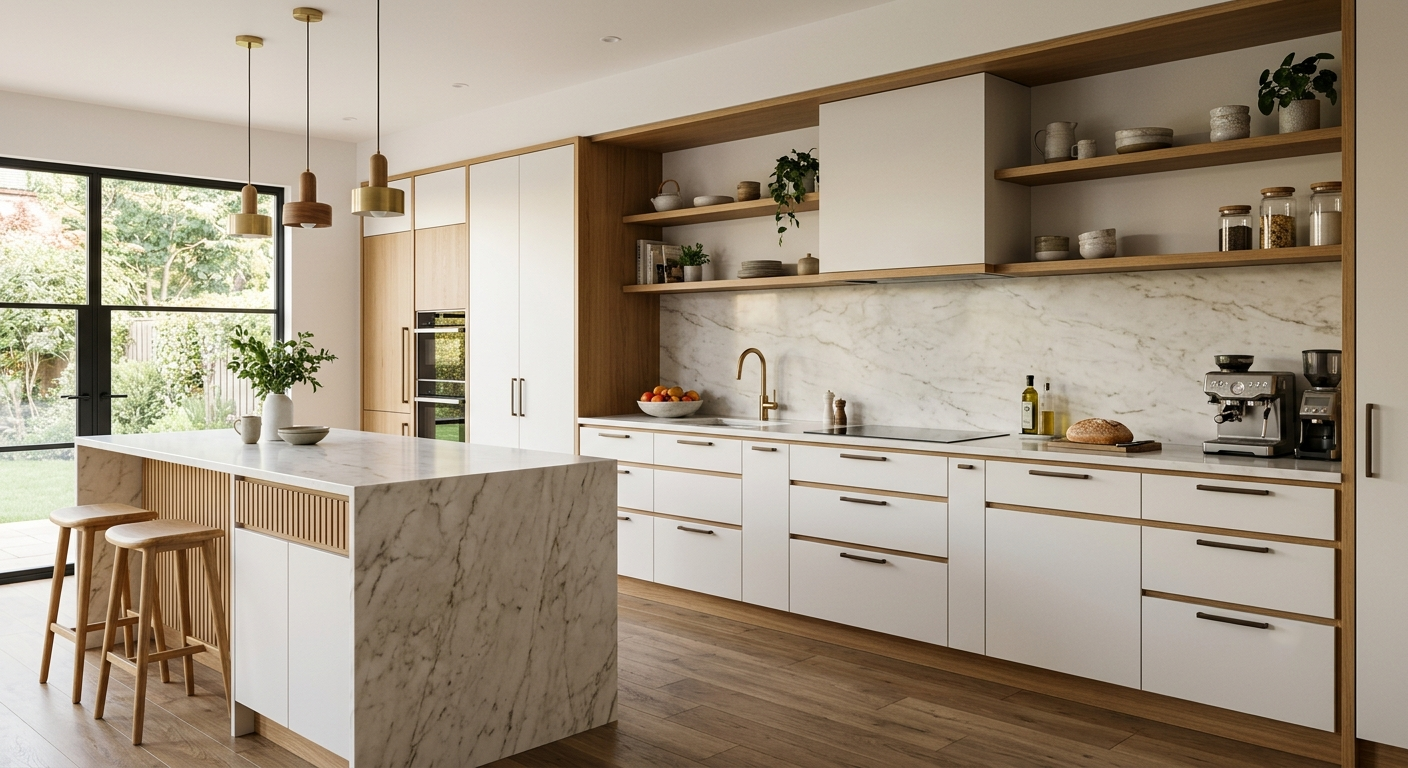
- Marble-inspired patterns for an elegant kitchen island.
Porcelain: Sleek and Contemporary
Porcelain can reproduce the appearance of marble, concrete, and other stone finishes. Its large-format slabs may allow fewer visible seams across certain layouts.
Design possibilities include:
- Marble-look porcelain for a luxurious appearance.
- Concrete-inspired finishes for contemporary interiors.
- Coordinated countertops and full-height backsplashes.
- Slim countertop profiles for minimalist designs.
Design tip: Request physical samples before making a decision. Lighting, cabinetry, flooring, and surrounding finishes can significantly influence how a countertop looks in your home.
5. Cost: Is Quartz or Porcelain More Affordable?
The total cost of a countertop depends on more than the material itself. Slab selection, countertop dimensions, edge details, cutouts, transportation, fabrication, and installation all affect the final price.
Quartz may be more economical for some standard kitchen layouts because fabrication is widely available. Porcelain can involve additional fabrication costs because its hardness and thinner slab options require specialized handling and equipment.
However, prices overlap, and neither material is automatically the cheaper choice in every project.
Before comparing estimates, make sure each quote includes the same scope of work.
Ask whether the estimate covers:
- Material and slab selection.
- Measurement and templating.
- Cutting and edge finishing.
- Sink and cooktop cutouts.
- Transportation and installation.
- Removal and disposal of existing countertops.
- Warranty coverage.
For an accurate comparison, request itemized estimates based on your actual kitchen dimensions and selected products.

6. Which Countertop Is Better for Los Angeles Homes?
Los Angeles homeowners may need to consider indoor kitchen layouts, outdoor entertaining areas, strong sunlight, and the overall style of their homes.
The right material depends on where the countertop will be installed and how it will be used.
Choose Quartz If You Want:
- A versatile surface for an indoor kitchen.
- A broad selection of colors and patterns.
- A variety of edge profiles.
- A low-maintenance surface for daily food preparation.
- A coordinated look with custom cabinets and contemporary finishes.
Choose Porcelain If You Want:
- Greater resistance to concentrated heat.
- A hard surface with excellent scratch resistance.
- Large-format slab designs.
- A contemporary, streamlined appearance.
- A countertop for an outdoor kitchen, provided the selected product is rated for exterior use.
For an outdoor kitchen exposed to direct sunlight, porcelain is generally the stronger candidate. Most engineered quartz products are not recommended for prolonged exterior exposure.
Always confirm the product’s suitability for the intended location before purchasing.
7. How to Choose the Right Countertop for Your Lifestyle
Before choosing between quartz and porcelain, consider how your household uses the kitchen.
Think about your cooking habits. If you regularly handle hot cookware, porcelain offers an advantage in heat resistance. If you choose quartz, make consistent use of trivets.
Consider daily wear and tear. Both materials resist many common forms of wear, but neither is immune to edge damage or heavy impacts.
Set a realistic budget. Compare complete installed quotes rather than relying on the advertised price per square foot.
Match the countertop to your cabinets. Warm wood, neutral painted cabinetry, and dark finishes can all work with either material when the colors and patterns are coordinated.
Choose an experienced installer. Fabrication quality affects the appearance and performance of the finished countertop. This is particularly important for porcelain slabs and detailed cutouts.
Taking time to evaluate these factors can help you avoid costly changes later in your renovation.
Frequently Asked Questions
Is quartz better than porcelain for kitchen countertops?
Quartz is an excellent option for many indoor kitchens because of its design flexibility, low maintenance, and forgiving edge characteristics. Porcelain is generally better for heat resistance and exterior applications when the product is appropriately rated. The best choice depends on your priorities.
Is porcelain more durable than quartz?
Not in every situation. Porcelain generally offers better heat and scratch resistance, while quartz can be more forgiving around edges and corners. Both materials perform well when properly installed and maintained.
Can you put hot pans on quartz countertops?
You should avoid placing hot pans directly on quartz. Extreme heat can damage its resin binder and cause permanent discoloration or cracking. Use a trivet or heat pad.
Do porcelain countertops stain easily?
Porcelain is generally nonporous and highly resistant to staining. Prompt cleaning is still recommended, and the manufacturer’s instructions should be followed for the specific surface finish.
Do quartz and porcelain countertops need sealing?
Most quartz and porcelain countertop products do not require routine sealing. Always verify the care instructions for your chosen product.
Which countertop is better for an outdoor kitchen?
Porcelain is generally the better option because exterior-rated products resist UV exposure and heat. Most engineered quartz countertops are intended for indoor applications.
Can quartz and porcelain be used together in the same kitchen?
Yes. You could use quartz for the main indoor countertop and porcelain for a suitable feature surface or outdoor kitchen. Coordinate the colors, thicknesses, edges, and installation details for a cohesive result.
Final Verdict: Quartz vs. Porcelain Countertops
There is no single winner for every kitchen.
Quartz is a strong choice for homeowners who want versatile designs, low-maintenance performance, and a practical surface for indoor food preparation.
Porcelain is worth considering when heat resistance, scratch resistance, large-format styling, or an approved outdoor application is especially important.
The smartest decision is to compare the exact products, review their warranties, and choose a material that suits your kitchen, cooking habits, and budget.
